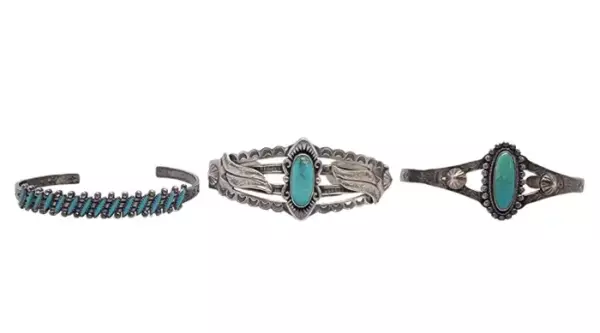
Bell Trading Post holds legendary status within the jewelry sector of the American Southwest. Established in 1932 in Albuquerque by entrepreneur Jacques Michelson, the firm began when he roamed New Mexico’s Indian reservations, purchasing turquoise and silver pieces from local artisans to sell via roadside stands along the newly constructed Highway 66 stretching from Illinois to Arizona.

In 1935, inspired by the methods of American designer-entrepreneur William Spratling in Mexico, Michelson launched his own workshop. He employed Native American artisans to dismantle and melt down heavy, bulky “traditional” Indian jewelry, repurposing the materials into lighter, more comfortable “new civilized” Indian pieces that retained authentic charm. From a single old Navajo item, Michelson produced at least three new items under the Bell Trading Post label.

By the mid-1950s, Michelson had leveraged significant savings on silver and turquoise costs to transform Bell Trading Post into “the most successful jewelry company in the American West.” Yet this success was short-lived: Michelson died in 1957, and the profitability of his roadside shops declined due to federal changes to Route 66.

In 1969, Jacques Jr. and Douglas Michelson, who inherited the business, chose to liquidate Bell Trading Post and relocate the family enterprise to Los Angeles. The Sunbell Corporation they established there operated until the late 1980s before quietly disappearing. Meanwhile, experts credit Bell Trading Post’s activities with sparking the emergence of the “South-West” jewelry style.